


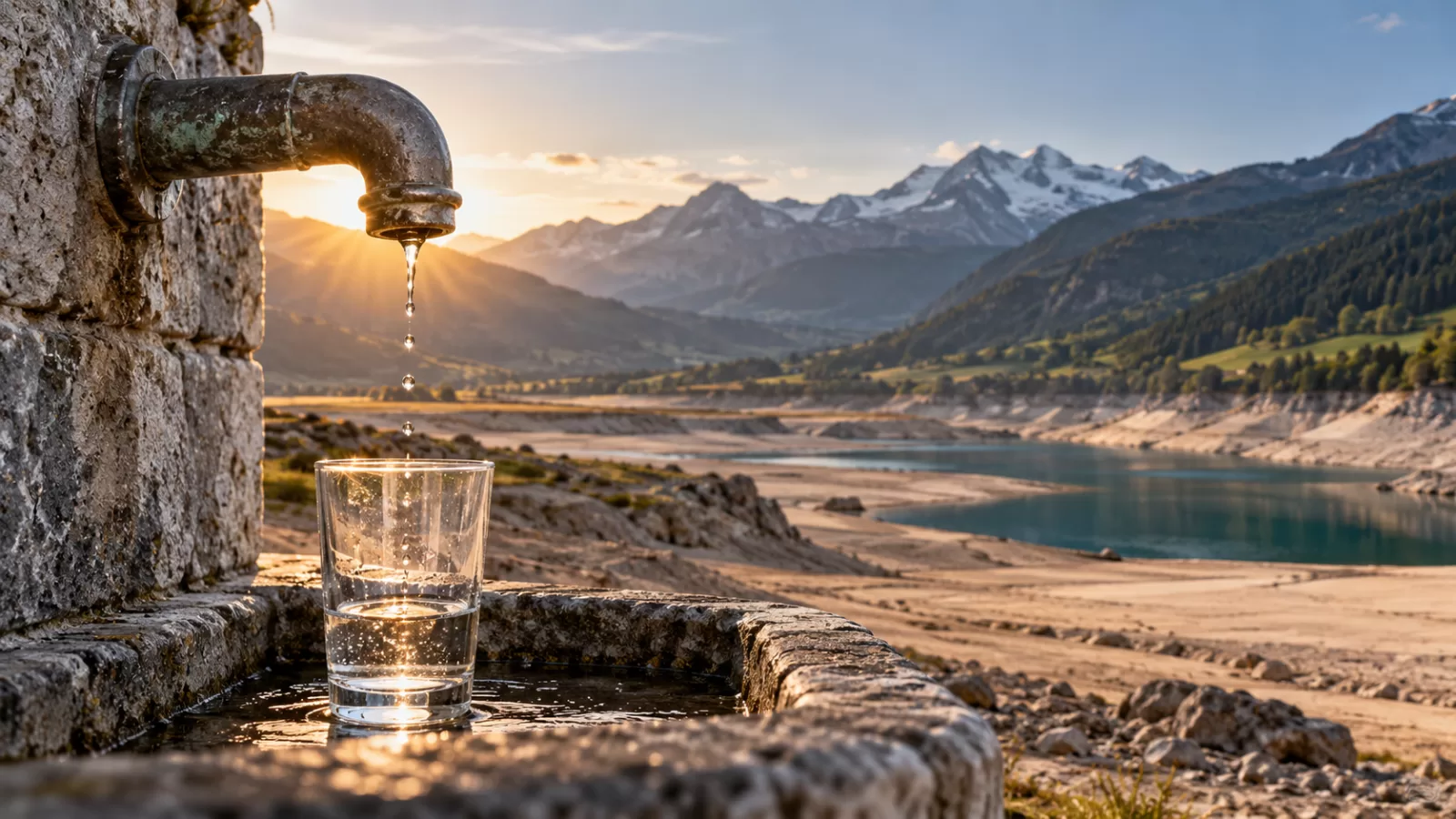
In the dry summer of 2026, taps across Switzerland continued to run reliably in most places. Yet streams were carrying record-low flows, springs were weakening and councils were asking people to use less water. There is no contradiction here. A dependable drinking-water supply depends not simply on how much water exists, but on whether enough of it is available in the right place, at the right time and through infrastructure with sufficient capacity.
Switzerland was nowhere near a nationwide drinking-water shortage. Some regions were nevertheless under strain, particularly small, poorly connected systems dependent on one spring or a vulnerable groundwater body. The drought did not create that fragility; it exposed it.
The warning signs appeared before summer
Drought develops in stages. When rain fails, the upper soil dries first. Vegetation comes under stress and small streams lose flow quickly. Larger groundwater bodies often respond only weeks or months later.
For drinking-water supplies, the winter half-year of 2025/26 was therefore crucial. At lower elevations, groundwater is replenished mainly during winter. In the mountains, snowmelt adds to that recharge in spring. Once the growing season begins, plants draw up more water and evaporation increases, leaving less precipitation to seep underground.
According to the Swiss Federal Office for the Environment (FOEN), the relatively dry winter of 2025/26 reduced groundwater recharge. Many groundwater levels and spring flows were already comparatively low at the start of summer. The drought that followed was working on natural storage that had already been run down.
Short thunderstorms moistened parched topsoil and briefly swollen some streams. They did not replenish deeper soils, groundwater or springs. Those systems need sustained rainfall over a broad area, with enough of it actually infiltrating the ground.
One summer, several very different water situations
About 80 per cent of Switzerland’s drinking water comes from groundwater and springs, with roughly 20 per cent drawn from lakes. Those figures alone say little about how a particular community will fare in a dry spell.
Large groundwater bodies in the Swiss Plateau and broad Alpine valleys can be several metres to several dozen metres thick. They hold substantial volumes and tend to respond slowly to a single dry period. Smaller, shallow bodies and local springs fluctuate much more sharply. The most exposed supplies are those that rely on one such source and cannot draw water from a neighbouring network.
Geology matters too. In karst areas, rain can disappear rapidly through fissures and cavities, but it can also drain away just as quickly. Springs there may respond to a lack of rain within a short time. Groundwater bodies alongside major rivers are often supported by infiltrating river water. If the river itself remains unusually low for a prolonged period, that buffer becomes less effective.
Two neighbouring communities can therefore experience the same summer but face entirely different problems. One may have a productive groundwater body and several interconnections; the other may depend on a spring whose flow has fallen markedly after months of scant rain.
The shortfall was still evident in autumn
Between 1 June and the end of August, new low-flow records for that period were recorded at just under 40 per cent of long-term discharge monitoring stations. Conditions were particularly severe in the central and eastern Swiss Plateau, the Pre-Alps and Graubünden.
The federal drought bulletin of 1 October 2026 still showed a substantial to severe precipitation deficit. In the Jura, along the northern Alpine foothills and in parts of the Swiss Plateau, only around 40 to 60 per cent of the usual rainfall had fallen during the preceding 90 days. In the Jura and the Swiss Plateau, flow deficits remained substantial to extreme in many areas.
Groundwater had not shown sustained recovery either. On the northern side of the Alps and in the Alps, groundwater levels and spring flows remained low, with most monitoring stations still pointing downwards. Rainfall could briefly steady small, shallow water bodies locally, but not in sufficient quantities to bring broader recovery.
These measurements describe natural water resources, not what comes out of the tap. Between the two lie abstraction points, treatment works, pumps, pipelines, reservoirs, quality checks and operational reserves.
Sometimes the bottleneck is the network, not the resource
A council’s request to save water can easily be read as evidence that an aquifer is running dry. Often, the pressure lies elsewhere. The Swiss Gas and Water Industry Association (SVGW) explicitly distinguishes between a scarce water resource and a capacity constraint in the supply infrastructure.
On hot days, demand can rise sharply: gardens are watered, pools are filled and people shower more often. Pumps, treatment plants, transfer mains and reservoirs, however, are designed for particular levels of performance. A natural resource may still contain enough water while the supply system cannot abstract, treat, transport or store peak demand quickly enough.
Pressure also rises when withdrawals from streams and rivers are restricted. Farms may then look for alternative sources and approach public water suppliers. A network that comfortably meets normal drinking-water demand can reach its technical limit when those additional volumes arrive.
Elsewhere, the problem really is a shortage of raw water. Small, poorly connected supplies that depend entirely on one or a few springs are especially exposed. If spring flow falls and there is no secured contractual source of supplementary water, there is little room to manoeuvre. The same request to use less water can therefore point to two quite different causes.
One resource, competing demands
Groundwater, lakes and rivers serve more than drinking-water supplies. During a drought, agriculture needs more water for irrigation. Industry and businesses require process or cooling water; power generation depends on adequate flows and permitted water temperatures. Rivers and streams must also retain enough water, at suitable temperatures, to prevent further harm to ecosystems.
That can create a distribution problem even where sizeable reserves remain in the region. An additional abstraction may be serious in a small catchment but acceptable where the resource is more resilient. Blanket solutions rarely fit the reality.
A reliable regional water balance must show what is available, how much is actually being taken and which ecological minimum requirements apply. It also needs rules for situations in which not every demand can be met at once. There are still gaps in the data, particularly on actual water withdrawals. Without that information, conflicts may become visible only once they are already acute.
Low levels do not automatically mean unsafe water
Falling groundwater levels first affect the quantity available. They do not, by themselves, show that the drinking water supplied to households is a health risk. A sound assessment must distinguish between the water resource, raw water and the treated drinking water entering the distribution network.
Drought can affect raw-water quality. With less water available, some substances may be diluted less effectively. Heavy rain after a prolonged dry spell can mobilise pollutants and temporarily place greater pressure on vulnerable, shallow abstraction points. None of this automatically tells you what is coming out of the tap.
Water suppliers are responsible for the quality of the drinking water they deliver and test it regularly. Cantonal laboratories oversee compliance. The Swiss Federal Food Safety and Veterinary Office (FSVO) generally assesses Swiss drinking water as good. Its latest national report, covering 2022 to 2024, nevertheless identifies protecting water resources, adapting to climate change and preventing local water shortages as continuing priorities.
For you, the relevant guidance is the notice from your council or water supplier. A request to use less water usually concerns available quantities or critical peaks in demand. If there is a quality issue — for example, advice to boil water — it will be communicated explicitly.
Resilience is built long before the crisis
The most useful reserve is often not a larger reservoir but a second, hydrologically independent source. That might be another groundwater body, a lake-water abstraction or a contractually secured connection to a neighbouring supply.
The SVGW estimates that around 90 per cent of Swiss water suppliers have some means of obtaining water from elsewhere. Connection alone is not enough. The link must have adequate capacity, purchasing rights must be agreed and the supplying network must still have reserves during the same drought. In mountainous areas, differences in elevation and long distances can make a connection technically difficult and expensive.
Forward planning brings together expected population growth, the condition of assets, available water resources, climate risks and possible demand peaks. Depending on local circumstances, the answer may involve new interconnections, additional abstraction points, larger reservoirs, more powerful pumping stations or regional cooperation. Such projects take years. If planning begins only once a spring has already weakened substantially, the options are limited.
Holding water in the landscape is becoming part of that resilience. Unsealed surfaces, rewetted wetlands and soils with good storage capacity can retain rainfall and release it more slowly. They cannot replace a secure drinking-water supply, but they strengthen the regional water cycle and ease pressure on watercourses during weather extremes.
What to do when your area asks you to save water
Your household’s consumption will not determine the condition of a large groundwater body. But when many people postpone or avoid high-volume uses at the same time, they can help break a critical peak — particularly when reservoirs are emptying faster than the system can refill them.
- Follow the latest advice from your council or water supplier. Conditions can differ sharply between neighbouring areas.
- Postpone filling a pool and other non-essential high-volume uses while an appeal to save water is in force.
- Water selectively rather than across the whole garden. Prioritise vulnerable plants over lawns and ornamental areas.
- Use stored rainwater where it is suitable for the intended purpose.
- Report unusual water leaks in public spaces to the responsible authority.
- Do not stockpile large quantities of drinking water unless the authorities advise you to. An appeal to save water does not mean that an interruption to supply is imminent.
These measures do not replace resource protection or investment in infrastructure. They can, however, give a strained supply system more time and operational headroom.
What 2026 revealed
A single dry summer cannot be attributed conclusively to climate change. The longer-term direction is nevertheless clear. According to the Swiss climate scenarios Climate CH2025, Swiss soils have become progressively drier in summer over the past three decades. Higher temperatures, stronger evaporation and declining summer rainfall are reinforcing one another. As climate change advances, summer drought will become more pronounced.
Since 2025, Switzerland has had a national drought early-warning and detection system. It brings together information on rainfall, soil moisture, river flows, water levels and groundwater, improving the shared assessment of conditions. It cannot, however, build missing interconnections, protect inadequate abstraction points or settle competing claims on water.
In August 2026, the Adaptation Network led by FOEN recommended, among other measures, more binding regional water-resource planning, better data on actual withdrawals and stronger coordination across cantonal boundaries. These recommendations are feeding into the ongoing national water-management strategy.
The drought of 2026 has unsettled the familiar assumption that water is limitless and immediately available everywhere in Switzerland. Whether a dry summer becomes a local drinking-water shortage is decided long before the next heatwave: through protected abstraction points, regional cooperation, dependable data and infrastructure built before it is urgently needed. Drought becomes a serious risk where natural and engineered reserves fail at the same time.
