


Published: 5 October 2026.
Some molecules make an impression simply by being named. Molecular hydrogen is not one of them.
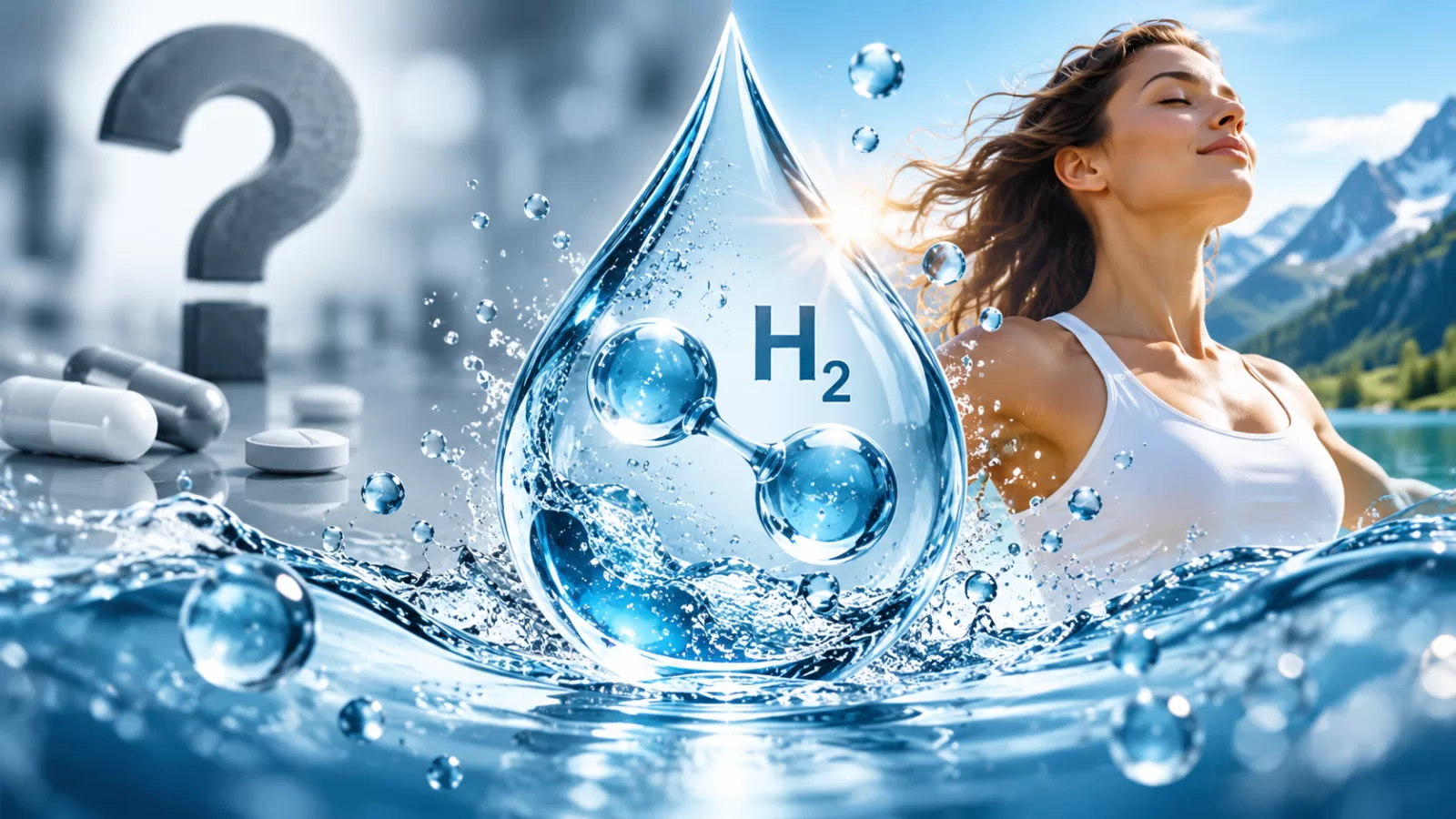
Two hydrogen atoms joined together as H₂. The smallest molecule there is. Colourless, odourless and unremarkable – so light that it is reluctant to remain where you would like it to be. Open a container of hydrogen water and H₂ is already beginning to escape into its surroundings.
This fleeting molecule has nevertheless occupied research groups around the world for almost two decades. It is drunk, inhaled and investigated in laboratories. Scientific papers examine oxidative stress, inflammatory processes, metabolism, neurological conditions, recovery and athletic performance.
Outside academia, the research subject has long since become a market. There, the claims often sound much more definite: H₂ is said to protect cells, support recovery, reduce inflammation, provide energy and help the body with an astonishing range of complaints.
Anyone looking into the subject will find enthusiastic personal accounts just as quickly as scientific publications. Somewhere between the two are people asking a perfectly sensible question:
What can molecular hydrogen really do?
To find a useful answer, we need to go back to an experiment published in 2007. That is where H₂’s modern story begins – along with a scientific hope that would later have to withstand some fairly searching tests.
When a tiny molecule suddenly became interesting
Japanese researchers investigated what happened when molecular hydrogen was inhaled during a temporary interruption to the brain’s blood supply. In the animal model used, H₂ reduced certain forms of oxidative damage. The researchers suggested that molecular hydrogen might affect particularly reactive oxygen and nitrogen compounds.
The finding was remarkable because hydrogen had long been regarded as a biologically rather unremarkable gas. Now there was a possibility that this extremely small molecule might, after all, do something in the body.
Other research groups took up the question. With each new study, the field widened. It was soon no longer concerned solely with oxidative stress. Scientists investigated possible links with cellular signalling pathways, inflammatory processes, gene expression, mitochondria and the body’s own protective mechanisms.
No simple formula of action has emerged to date. If anything, the more we learned about H₂, the less convincing became the popular image of a small ‘free-radical scavenger’ travelling through the body and neutralising harmful molecules along the way.
The biological relationships appear to be more complicated.
That is what makes H₂ scientifically interesting. At the same time, it introduces a distinction that is crucial to almost everything that follows:
A biological effect is not yet a medical benefit.
The distance between an altered cell and a healthier person is considerable
In a laboratory, researchers can measure whether a particular marker changes. In animal models, they can examine whether tissue sustains less damage under certain conditions. In people, blood values, inflammatory markers, lactate or markers of oxidative stress can be compared before and after an intervention.
All of that is research. And all of it can matter.
For someone drinking hydrogen water, however, the really interesting question begins one step later.
Do they actually feel better as a result?
Does their physical performance improve? Do they recover more quickly? Does their quality of life rise? Are there fewer complications? Does a disease progress more slowly? Do they need medical treatment less often?
A laboratory value may be valuable on the way to answering such questions. It is not the answer itself.
The distinction sounds obvious. In the world of health products, it is remarkably easy to lose sight of it. ‘A study changed a biomarker’ quickly becomes ‘supports health’. An interesting mechanism becomes a benefit – and a benefit eventually becomes a promise.
Research into H₂ offers a particularly clear example of why science cannot take that shortcut.
17 people, a positive result – and a great deal of hope
An early randomised, double-blind study examined hydrogen water in people with Parkinson’s disease. After 48 weeks, the researchers reported an advantage over placebo.
The number of participants analysed was small, however: 17.
A study of this size can uncover something important. It cannot yet reliably answer whether the same effect will occur in a larger and more diverse group of people.
That is precisely why the research did not end there.
A later multicentre, double-blind study revisited the question. This time, 178 people were randomised and followed for 72 weeks.
The hoped-for difference did not appear.
For the overall Parkinson’s symptom score, hydrogen water showed no significant advantage over placebo. Nor did important subdomains or quality of life provide the confirmation one might have hoped for after the early positive signal. Another small placebo-controlled trial of inhaled H₂ likewise found no clinical benefit.
This did not suddenly make the first study meaningless. Rather, it gave the finding something science cannot do without: a second test.
Small studies can detect genuine effects. They can also overestimate effects, capture differences that occurred by chance or examine a group of people who are not representative of everyone else.
Only when a finding reappears under different conditions does an interesting signal begin to become robust knowledge.
That confirmation has not yet emerged in Parkinson’s disease.
Then 675 more people took part
During the COVID-19 pandemic, molecular hydrogen had another opportunity to prove itself in a considerably larger clinical study.
Six hundred and seventy-five outpatients took part in a randomised, triple-blind phase 3 trial. The study examined whether hydrogen water could prevent clinical deterioration.
Again, the answer was sobering: H₂ was no better than placebo for the primary endpoint.
Negative results like this are particularly valuable when assessing health claims. The study was not merely asking whether some laboratory value changed. It wanted to know whether the people affected experienced a clinically meaningful difference.
In this case, they did not.
Anyone who reads only positive H₂ studies will therefore inevitably form a different impression from someone who also considers what happens when promising hypotheses are tested in larger studies.
That still does not mean that molecular hydrogen ‘does nothing’.
In other areas of research, the picture is less clear-cut.
Sport is where the grey area begins
Studies in healthy adults suggest that H₂ may influence some physiological or subjective measures. Meta-analyses have reported small effects, for example, on perceived exertion, lactate levels or individual performance parameters.
At the same time, no consistent, meaningful improvements have been demonstrated in maximal oxygen uptake, aerobic or anaerobic endurance, or muscle strength.
That is more interesting than it may initially sound.
Under certain conditions, a person might feel less exhausted without being able to perform substantially more objectively. A blood value might change while measured endurance remains almost identical.
Both things can be true at once.
Small randomised studies of metabolic disorders have also observed changes in individual blood lipid, inflammatory or metabolic values. What those changes might mean in the long term – for example, in relation to diabetes complications or cardiovascular disease – remains unanswered.
Some more recent studies are still tiny, too. A placebo-controlled study of H₂ inhalation in ulcerative colitis published in 2025, for example, included just ten people.
Such studies can open a door. Larger trials will have to show whether there is anything genuinely behind it.
You might still feel something
This brings us to a part of the H₂ debate where science and personal experience can easily misunderstand one another.
Someone drinks hydrogen water and says: ‘I feel better when I use it.’
A study finds no clear clinical effect.
Those two statements do not necessarily contradict each other.
Expectations can influence how we perceive tiredness, pain, sleep, mood or wellbeing. That does not mean the symptoms are imagined. Our experience is not formed independently of what we expect, what we notice and what we have experienced before.
There are also more ordinary changes. Someone starting a new health routine may drink more water. They may pay closer attention to their diet or exercise at the same time. Perhaps they begin sleeping more deliberately. Perhaps they started using the product during a particularly difficult period – and some of the subsequent improvement would have happened anyway.
Statistics has a term for this: regression to the mean.
With H₂, there is another consideration. Dissolved hydrogen is colourless, tasteless and odourless. A placebo can therefore, in principle, be made convincingly. In practice, bubbles, packaging pressure, preparation, a reacting tablet or the noise of a generator may reveal who is receiving which treatment.
A study can therefore be ‘placebo-controlled’ without achieving perfect blinding.
That helps explain why the most honest answer to the question ‘Placebo or effect?’ is currently neither an enthusiastic yes nor a dismissive no.
There are biological signals that deserve further research. There are positive individual findings. There are also studies in which anticipated clinical benefits were not confirmed. And there are subjective experiences whose causes are difficult to disentangle cleanly in everyday life.
Anyone turning that into a miracle cure is going beyond the science.
Anyone dismissing it all as pure imagination is doing the same.
Anyone wanting to try H₂ faces a rather different question
You do not have to wait for a future medical guideline before finding hydrogen water interesting.
People try new foods, training methods and technologies long before every conceivable scientific question has been conclusively answered. What matters is knowing what has been established, what is still being investigated – and what is merely a marketing claim.
With hydrogen water, the question therefore shifts from medicine to engineering:
If I want to drink H₂, how can I get it reliably into the glass?
The very property that makes hydrogen biologically interesting also makes it difficult to use in practice. The H₂ molecule is extremely small and volatile. Once dissolved in water, it does not stay there indefinitely.
After production, hydrogen begins to escape. Temperature, movement, container material, closure, storage time and the headspace in the container all affect how much is still present when the water is actually drunk.
The concentration measured at some point during production may therefore not be the concentration that reaches the glass later.
A large ppm figure tells only half the story
In water, 1 ppm corresponds in practice to approximately 1 milligram of dissolved H₂ per litre.
Half a litre of water with an H₂ concentration of 1.6 mg/l contains, in theory, no more than 0.8 milligrams of molecular hydrogen. That applies only if the stated concentration is still present when the water is consumed.
That gives an impressive ppm figure on a product page some rather less glamorous, but more important, company:
When was it measured? Using which method? How much water is actually consumed? How long passes between production and drinking? What container is the water in? And can the result be reproduced under realistic conditions?
A strongly negative oxidation-reduction potential, often reported as ORP, does not answer these questions either. ORP is significantly influenced, among other things, by pH and does not provide a reliable way of calculating the actual concentration of dissolved H₂.
Anyone wanting to assess hydrogen water seriously should therefore focus less on spectacular individual figures and more on the technical system as a whole.
That is precisely what HYDRO-PRO is designed for
SANSEI works with water. It would therefore be easy for us to turn the fascination surrounding H₂ into as large a health story as possible.
We have deliberately chosen the more difficult route.
We do not promise that molecular hydrogen cures diseases. We explain that research is investigating interesting biological effects, that positive signals exist – and that many far-reaching health claims still lack robust clinical confirmation.
If you nevertheless want to experience H₂ for yourself and incorporate it into your daily routine, we would like to offer you a technically convincing solution.
The HYDRO-PRO hydrogen generator from SANSEI was developed for precisely this purpose: to provide molecular hydrogen where it is needed – fresh and immediately before drinking.
With a volatile gas, that is not a minor detail. The shorter the journey between generation and glass, the less time dissolved H₂ has to escape back into the surrounding air.
For us, HYDRO-PRO is therefore not a device for selling medical promises. It is a high-quality technical solution for people who, having informed themselves, consciously decide to use hydrogen water.
And this is where a good product should differ from a good marketing promise: a promise has to be believed. Technology can be assessed.
Discover HYDRO-PRO → See how it works, how to use it and its technical details
Hydrogen does not turn poor-quality water into good water
One point is remarkably easy to overlook amid the enthusiasm for H₂: a hydrogen generator is not a water-treatment system.
Adding molecular hydrogen to water does not remove unwanted chemicals or possible microbiological contamination. The quality of the source water and H₂ enrichment are two separate tasks.
This is particularly relevant with electrolytic systems. Water composition, electrode material, cell design, separation of the electrolysis compartments, cleaning and maintenance all form part of assessing a device.
Depending on the design and the source water, unsuitable electrolysis can produce unwanted by-products.
Anyone interested in hydrogen water should therefore ask not only how much H₂ a device produces. It is equally important to ask what kind of water it produces that hydrogen water from.
And why not simply inhale more H₂?
Because drinking and inhalation are two entirely different applications.
With hydrogen water, a limited amount of H₂ is absorbed over a relatively short period. Some enters the body and is subsequently released, among other routes, through the lungs.
With inhalation, by contrast, hydrogen can be supplied continuously over a longer period. That changes exposure and concentration over time – but it also changes the technical risks.
Hydrogen is highly flammable. Certain mixtures with air or oxygen can ignite. Concentration, gas flow, device design, ventilation and potential ignition sources therefore become safety considerations in inhalation systems.
For this reason, a study involving inhaled H₂ cannot be equated technically or medically with a glass of hydrogen water.
That sounds obvious. In marketing claims, the boundary nevertheless becomes blurred remarkably quickly.
In Switzerland, marketing freedom ends where hope becomes a cure
The fact that H₂ research still contains unanswered questions is entirely normal scientifically. For product marketing, however, how those unanswered questions are handled makes a considerable difference.
Food and medicinal products are subject to different rules in Switzerland. If hydrogen water is marketed as a food, skilful wording cannot suddenly give it therapeutic properties.
Claims that a food can cure or treat disease are not permitted. Health claims are regulated too and cannot be derived arbitrarily from individual studies.
This applies not only to a product label. Websites, social media posts, testimonials, images and linked content may also form part of commercial communication.
There are only a few words between ‘molecular hydrogen is being investigated for possible biological effects’ and ‘molecular hydrogen protects you from disease’.
Legally and scientifically, they are worlds apart.
So what remains?
Almost twenty years after an unremarkable experiment brought H₂ to the attention of a new generation of researchers, we know considerably more about molecular hydrogen.
The answer has simply not become as straightforward as supporters or critics might have wished.
H₂ is not an imaginary product. The molecule can be measured, enters the body after uptake and is linked to biological processes that are being investigated seriously. Some human studies report interesting effects. Others, including large and methodologically demanding investigations, have not confirmed the hoped-for clinical benefits.
That is not enough to declare molecular hydrogen a miracle cure.
But it is equally insufficient to dismiss almost two decades of research with the word ‘placebo’.
Perhaps that is precisely what makes this tiny molecule so compelling. It forces us towards an attitude that can seem almost old-fashioned in a world full of quick health promises: remain curious without becoming credulous. Investigate possibilities without turning them into certainties. And judge a technology by what it can actually do.
For SANSEI, that also means being able to sell something without having to sell you a miracle along with it.
If, after reading this article, you say: ‘The research is not there yet, but H₂ interests me and I would like to try hydrogen water for myself’, that is where our role begins.
With good water quality. With carefully considered technology. And with an H₂ system whose purpose is not to cure disease, but to provide fresh molecular hydrogen for everyday use.
Find out more about the HYDRO-PRO hydrogen generator →
Sources and further information
This article draws on scientific publications and information from Swiss authorities. The research presented is intended to provide an objective overview of molecular hydrogen and does not constitute a medical treatment recommendation.
- Federal Food Safety and Veterinary Office (FSVO) – Food supplements
- Federal Food Safety and Veterinary Office (FSVO) – Nutrition and health claims
- PubMed Central – Scientific publication on molecular hydrogen and clinical research
- PubMed – Human study of molecular hydrogen
- PubMed – Current clinical research into H₂
- PubMed Central – Review of research into molecular hydrogen
