


A filter claim is only as useful as the evidence behind it. To understand what a water treatment system changes, you need three things: measurements before and after treatment, and a clear account of the test conditions.
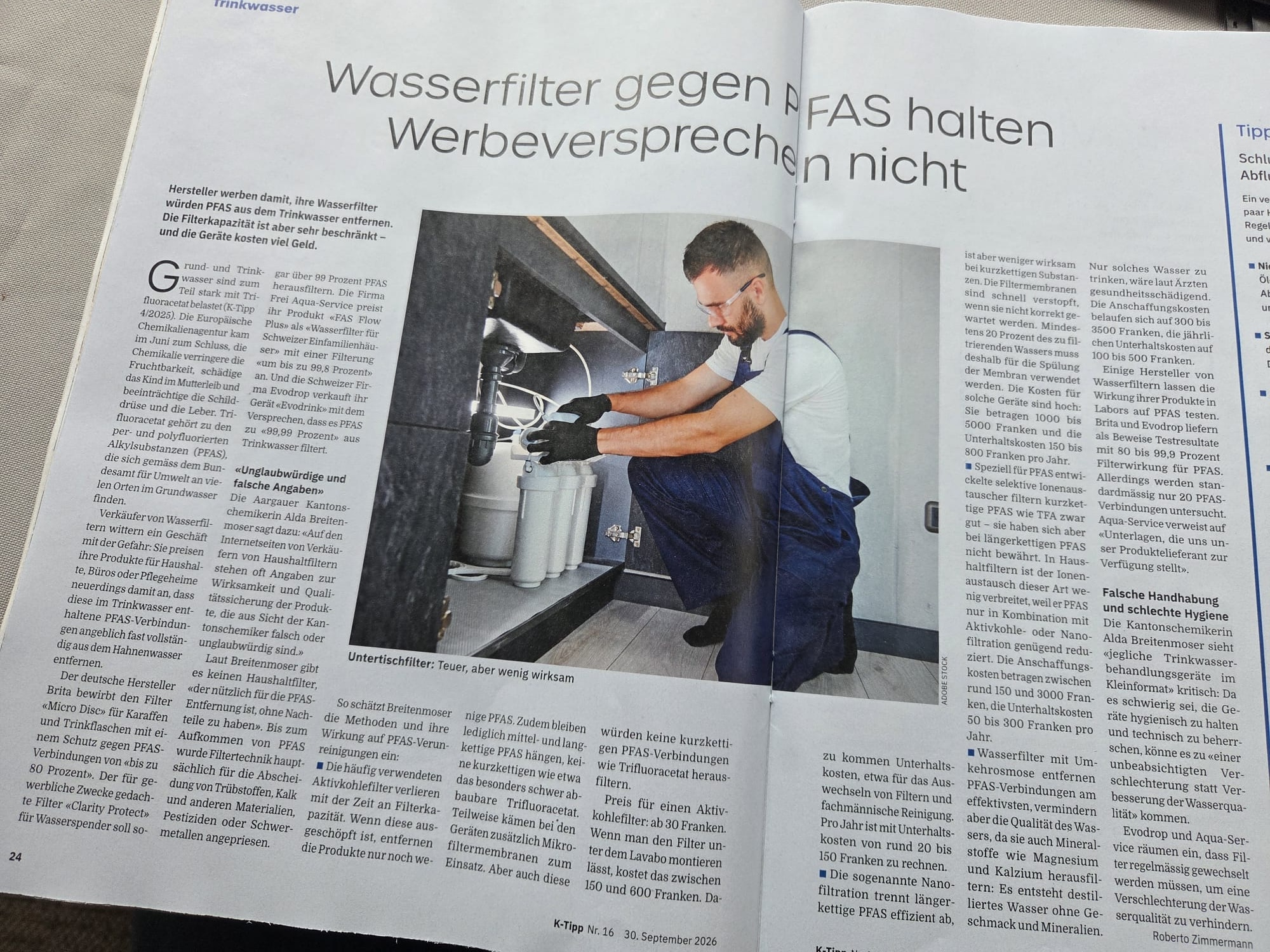
A K-Tipp article published on 30 September 2026 asks a fair question: do water filters live up to their PFAS claims? Its criticism of poorly substantiated statements matters. But the technology, the particular system and its measured performance are not interchangeable — and some of the article’s conclusions about filtration methods and low-mineral water need more context.
Read the K-Tipp article of 30 September 2026 — a K-Tipp subscription is required.
What one BUBBLE-COOL installation achieved
At one BUBBLE-COOL installation, an independent Swiss laboratory analysed the water before and after treatment. Reports issued by Umweltcheck.ch / Triwa AG record the following results:[2][3]
| Parameter | Before treatment | After treatment |
|---|---|---|
| Sum of PFAS[4] | 0.068 | < 0.010 |
| Sum of PFAS[20] | 0.076 | < 0.010 |
| PFOS | 0.06030 | < 0.00768 |
The PFOS result is particularly clear. PFOS was measurable before treatment; afterwards, the result was below the stated limit of quantification. Based on the reported figures, this represents a calculated PFOS reduction of more than 87%.
The less-than sign does not mean that no PFOS remained. It means the laboratory could not report an exact concentration below that threshold, so the true reduction may have been greater. The summed values are reproduced exactly as they appear in the reports; their interpretation also depends on how the laboratory includes individual results below the limit of quantification when calculating each total.
This is evidence from a specific pair of samples, not a blanket guarantee covering every source-water composition, every PFAS compound or the filter’s entire working life.
View the BUBBLE-COOL analysis report before treatment
View the BUBBLE-COOL analysis report after treatment
Without a starting point, the result is incomplete
A result below the laboratory’s limit of quantification after filtration does not by itself prove a reduction: the substance may already have been below that limit in the untreated water. Below this threshold, the laboratory cannot reliably state the concentration as a precise numerical value.
That is why SANSEI favours before-and-after analysis. It shows what was measurably present in the source water and how the result changed after treatment. Without the starting measurement, a reassuring figure may say less than it appears to.
PFAS is a family of compounds
A filter may retain some PFAS far more effectively than others. Activated carbon, for example, generally binds many long-chain PFAS more effectively than short-chain compounds. Performance and service life also depend on the filter medium, contact time, source-water composition and the volume of water already treated.
The US Environmental Protection Agency identifies activated carbon, suitable anion-exchange resins and membrane technologies such as reverse osmosis as effective treatment methods. Their effectiveness depends on the PFAS present and on the system’s design and operation.[1]
A percentage reduction is therefore meaningful only if you know which substances it covers, the conditions under which it was measured and whether that performance is maintained until the scheduled filter change.
TFA requires evidence of its own
Trifluoroacetic acid, or TFA, is an ultra-short-chain PFAS and must be assessed separately. It was not included in the linked laboratory analyses, so these results do not show how much TFA the BUBBLE-COOL reduces.
Conventional activated carbon is unsuitable for removing TFA. In one experimental study, the reverse-osmosis system tested retained TFA completely. That finding applies to the conditions studied; it does not demonstrate the performance of a particular domestic appliance.[4]
Installation is only the beginning
Maintenance, hygiene and transparent ongoing costs belong in any proper assessment of a water treatment system. Filters must be changed on time and systems maintained in accordance with the manufacturer’s instructions, as the EPA expressly notes.[9]
Both the reverse-osmosis BUBBLE-COOL and the ULTRA-SLIM continuously monitor the water’s electrical conductivity. If the system no longer maintains the specified conductivity level, you receive a membrane-maintenance recommendation by email.
The recommendation is based on measured performance under your actual water conditions, rather than solely on a fixed timetable. Because source-water composition and usage affect how long the membranes continue to perform, the timing of the corresponding maintenance cost follows the system’s actual needs. This can avoid replacing a membrane unnecessarily early.
Conductivity monitoring helps identify changes in membrane performance. It does not replace laboratory analysis when you need evidence for individual substances such as PFAS. Scheduled filter changes and hygienic maintenance remain essential.
Reverse osmosis is not distillation
Distillation evaporates water and then condenses it. Reverse osmosis uses pressure and a selective membrane instead. Many dissolved substances are retained and discharged in a separate concentrate stream.[5]
The process also reduces calcium and magnesium. The treated water is therefore lower in minerals, but it is not automatically completely demineralised, nor is it distilled. Its final composition depends on the source water, membrane and system design.
Putting low-mineral water into context
Germany’s Federal Institute for Risk Assessment has assessed mineral water, spring water and table water with very low mineral content. Based on current knowledge, it does not expect adverse health effects where people have a balanced diet and drink customary quantities, although it also identifies gaps in the available evidence.[6]
This is not blanket approval for every filtration system. It does show that low mineral content alone does not make water harmful. Your overall diet and fluid intake matter, as does the water’s hygienic quality.
If your diet is unbalanced, you fast for an extended period or you have particular nutritional requirements, consider your mineral intake as a whole. The same applies during pregnancy and breastfeeding. For prolonged physical exertion, the Institute does not recommend very low-mineral water as the sole or principal drink for fluid replacement.
The mineral contribution depends on your water
Calcium and magnesium come from a range of foods and drinks. How much tap water contributes varies considerably with local water composition. The World Health Organization notes that this contribution can be relevant where dietary intake is limited.[7]
If your water contains 100 mg of calcium per litre, drinking two litres provides 200 mg — 20% of the recommended daily intake of 1,000 mg for adults. At 20 mg per litre, the contribution would be 4%. These are examples; the analysis supplied by your water provider will show which calculation applies to you.[8]
Minerals in water may therefore make either a modest or a meaningful contribution. A balanced diet remains the foundation. Any sound recommendation should take account of your water composition, the treatment you want and how the system will fit into everyday life.
Start with your water, not the sales claim
If you are considering water treatment, begin with the data from your water provider and your own requirements. SANSEI will help you determine which solution fits, what evidence supports it and what ongoing care involves.
The right decision starts with knowing what is in your water — and what the chosen system can demonstrably change.
BE HEALTHY – FOR PEOPLE AND NATURE.
