


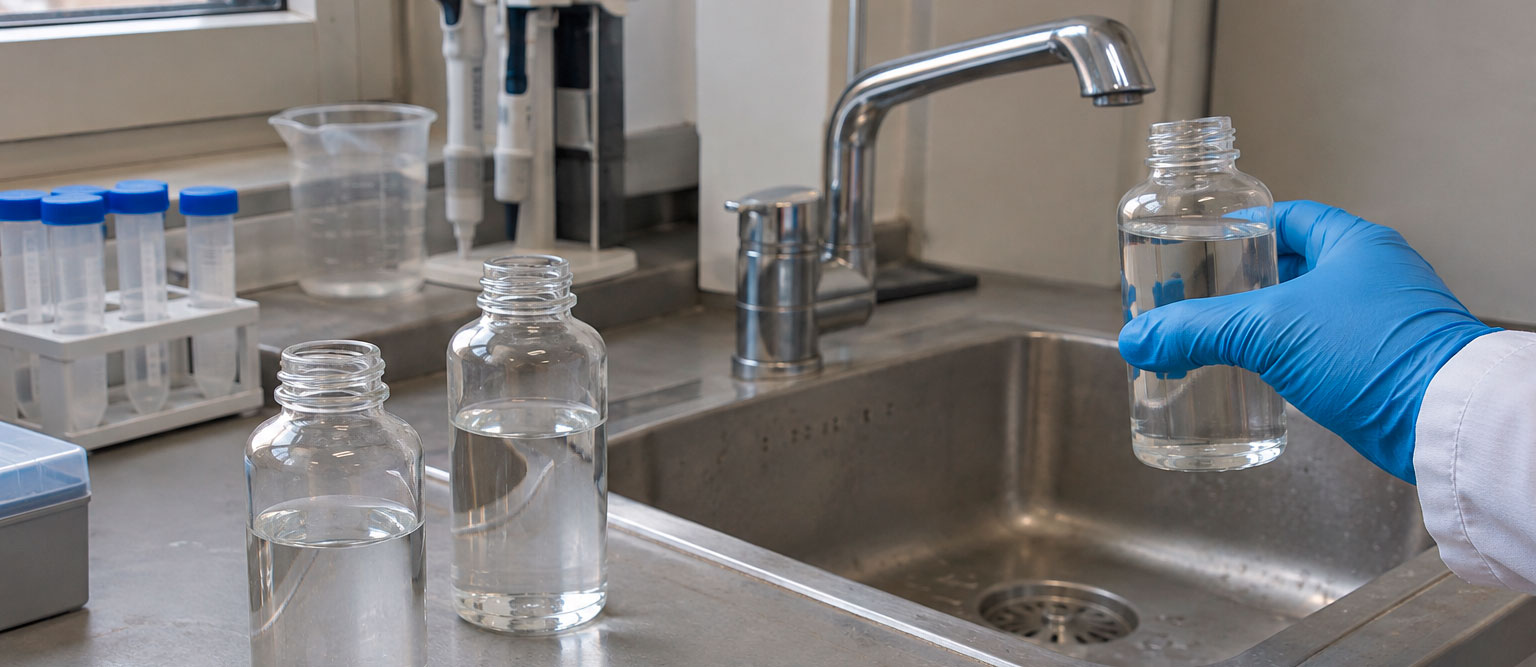
A water filter can remove certain PFAS from your drinking water. That does not make them disappear. They remain in the filter material or are diverted into a separate water stream. For the glass in front of you, that is a meaningful difference. For the environment, it is where the next problem begins.
Recent research is therefore looking beyond the question of how PFAS can be captured. It is also examining what can be done with them afterwards — an issue we at SANSEI innovations are exploring closely.
The claim is only as useful as the test behind it
If you see a statement such as ‘reduces PFAS’, start with the test report. Which compounds were measured? Under what conditions? And was only a new cartridge tested, or was its performance checked after prolonged use as well?
A result for individual PFAS does not automatically demonstrate the same effect for TFA. The research discussed here is therefore not performance evidence for SANSEI devices.
Capture is not destruction
Reverse osmosis separates water by forcing it through a membrane. Substances held back by the membrane collect in what is known as the concentrate: the water stream that is not used as drinking water. At this stage, the contaminants have been separated, not destroyed.
The Swiss Oekotox Centre describes this dilemma in relation to TFA, a particularly small and mobile PFAS compound. Membrane processes can separate TFA, but they also produce a concentrated wastewater stream. Methods that genuinely destroy it are still under development.[1]
The important question is consequently not only how much remains in the drinking water, but where the rest ends up.
A smaller stream may make safer treatment possible
One research team has investigated whether fine air bubbles can separate certain PFAS from water. In simple terms, the compounds gather at the boundary between air and water. They can then be skimmed off with the foam that forms.
Tests using natural raw water and industrial wastewater suggest that the approach has potential. Its performance, however, changed considerably depending on the water’s composition and the PFAS concentration. A strong result in one type of water is therefore not a guarantee for another.[2]
The attraction of the method is that it can collect the compounds in a smaller volume, which can then be treated more selectively. The study does not, however, demonstrate the removal of TFA.
Disappearing from the test is not the same as becoming harmless
In a separate experiment, the researchers treated a laboratory-made PFAS concentrate with ultraviolet light and sulphite. Several of the parent compounds examined could no longer be detected afterwards. Others were removed much more slowly and only partially.[2]
That is a step forward in research, but measuring the original compounds alone is not enough for a final assessment. It is also essential to establish which intermediate products are formed and how far the fluorinated compounds have actually broken down.
A credible end-to-end solution must demonstrate both sides of the process: removal from the water and safe management of what remains.
Taking responsibility beyond the tap
At SANSEI innovations, we are looking closely at what happens to the contaminants retained during filtration. That is why, at the end of October 2026, we began working with a university research institution.
Together, we want to investigate how the concentrate from our reverse-osmosis systems can be treated further. The aim is to prevent the PFAS collected there from returning to the environment through wastewater, instead separating them deliberately and passing them on for safe further treatment.
In time, this could take our systems a step further: not only holding back certain contaminants from drinking water, but also helping to reduce their return to the environment.
The joint research and development work will show which methods are suitable and what environmental benefit they genuinely deliver. That assessment must include cleaning performance, energy demand and the safe handling of the residues left behind.
Our responsibility for water does not end at the tap. It begins a new chapter there: making sure that what we send down the drain, flush away or release through the washing machine does not simply find its way back into the water cycle.
